Best Navattic alternative for repo first teams
A repo-first comparison of the best Navattic alternative options, ranked by update burden, ownership, pricing, and how they handle product changes after launch.

Ship weekly for a quarter and your demo goes stale roughly thirteen times. On a screenshot-based tool, each stale demo means re-capturing every affected screen. That cost adds up fast: every UI change, every nav restructure, every pricing page refresh. Most Navattic alternative comparisons gloss over that part. If your team already lives in a repo and uses Cursor, Claude Code, or Codex, the best Navattic alternative is the one that keeps demo updates inside that workflow instead of adding another SaaS dashboard to babysit.
What repo-first teams actually need from a Navattic alternative
The workflow test
The question is not which tool has the cleanest editor. It is whether a demo update lives in the same loop as a product update. For a repo-first team, that means: push a UI change, run an agent prompt, and the demo reflects the new state. No context switch to a vendor dashboard, no re-recording screens, no manual annotation pass. Demo maintenance should scale with agent prompts, not with screen counts.
Why Navattic's strength is also the trap
Navattic is a strong GTM tool. HTML capture from the free tier, solid personalization, a clean no-code editor, all of it is built for sales and marketing teams that own the demo motion and run demos on a predictable cadence. That's a real use case, and Navattic handles it well.
The trouble starts when a product team ships often. Every UI change that touches a captured screen means re-working the demo in Navattic's dashboard. The demo lives in a SaaS-locked artifact, not in code next to the product. For a team on weekly sprints, that is not a one-time setup cost. It is a recurring tax on every release. Navattic's free tier caps at one demo; the next step is Base at $500–600/mo for 5 seats, which makes sense for a sales org and less sense for a solo founder.
How we judged the best Navattic alternative options
What the table measures
Three things: what the demo artifact actually is, how much work a UI change creates after the first demo ships, and the lowest price at which the maintenance-relevant capability is available. That last one matters because several tools hide HTML or in-place edit features behind tiers that are simply too expensive for the reader this article is aimed at.
What counts as a win for technical buyers
The winner is the tool that keeps demo maintenance cheapest after the first ship, not the one with the fastest initial capture. A tool that gets you from product to shareable demo in 20 minutes but costs an hour of re-capture per sprint is more expensive over a quarter than a tool that takes 30 minutes to set up but updates with a single prompt. Comparison sites usually miss that. The table below does not.
Best Navattic alternatives compared for maintainability
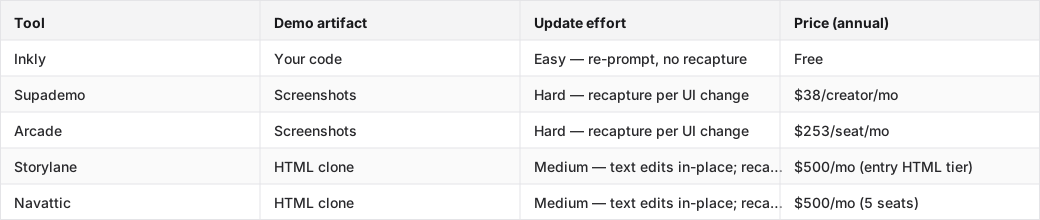
Here's how the main interactive demo tools compare on artifact type, update effort, and entry price at the tier that actually delivers the ranked capability.
Tools compared: Inkly, Supademo, Arcade, Storylane, Navattic.
Why the table puts some tools near the bottom
Storylane Growth ($500/mo annual) and Navattic Base ($500/mo annual) are both solid options for a funded GTM team. They are just off-budget for a solo founder or product engineer looking at maintenance costs. Arcade's HTML capture is Enterprise-only, so Growth ($253/seat/mo) is screenshot-only, which puts it in the same recapture loop as Supademo at a higher price. None of these are bad tools. They are just built for a different buyer.
Pick the Navattic alternative that matches your workflow
When speed matters more than ownership
You need a demo for a pitch on Friday and you are not running a coding agent yet. Supademo is the right call. Scale tier is $38/creator/mo annual, so it is affordable and self-serve, and the capture flow is the cleanest in the category for getting from product to shareable demo quickly. The tradeoff is simple: every UI change means re-capturing the affected screens, and there is no HTML tier under Growth at $350–450/mo. If your product ships rarely, that is fine. If you ship weekly, it gets old fast.
When your repo and your demo should move together
You are already prompting your way through product changes with Cursor or Claude Code. The code-native demo workflow is the natural fit. The demo lives in your repo, updates when the product updates, and a new customer variant costs a prompt, not a re-record. Inkly is built on that idea: the demo is code you own, off-platform, and agent-authored. The tradeoff is real. You need a coding agent already set up, and Inkly's hosted in-app agent is roadmap, not shipped today. Bring-your-own-agent is the current path.
When GTM features are the real requirement
Your team needs per-account branching, lead capture forms, CRM integrations, and a demo center that sales reps can run without touching a repo. That is a different job. Storylane Growth ($500/mo annual, 5 seats, trial-request) and Navattic Base ($500/mo annual, 5 seats) are the right tools here. The feature lists tell you who they are for: Salesforce integration, A/B testing, personalization tokens, dedicated CSMs. Repo ownership is not the priority; sales workflow is.
The best Navattic alternative for builder-led teams
Why the winner is not the prettiest editor
The Gartner Peer Insights alternatives list for Navattic surfaces tools like Storylane, Arcade, and Consensus. They are all fine for GTM teams. For a builder-led team, the ranking flips. What matters is what happens the second time you need to update the demo, not how polished it looked on day one.
For a repo-first founder or product engineer, Inkly ranks first on the maintenance axis: the demo is code you own, updates via agent prompt, and costs nothing at the entry tier. Supademo ranks second. It is the most practical self-serve compromise if you are not running a coding agent yet, it is affordable at $38/creator/mo, and it is fast enough for the first demo. Arcade Growth ($253/seat/mo) is screenshot-only at the self-serve tier, which makes it harder to justify over Supademo on price. Storylane and Navattic are strong tools for the wrong buyer at this budget.
What you give up if you optimize for maintenance
Bring-your-own-agent is a real barrier. If your team does not already have Cursor, Claude Code, or Codex in the workflow, the code-native path adds setup friction that a Supademo capture does not. Inkly does not have an in-app hosted agent today, and that is a roadmap item. For a PMM or non-technical founder who wants to click through a demo editor without opening a terminal, Supademo is the cleaner first step. The maintenance cost is higher per sprint, but the day-one friction is lower.
Where Inkly comes in
The structural problem this article keeps coming back to is simple: most demo tools make the demo a SaaS-locked artifact. When the product changes, the demo does not move with it. You go back to the vendor dashboard, re-capture the affected screens, re-annotate, re-test. That loop is fine if you ship a demo once. It is expensive if you ship every sprint.
The tool that actually solves this keeps the demo as code next to the product, so an agent can re-author it from a prompt the same way it re-authors any other file in the repo. That is what Inkly is built on. Chrome-extension capture for the first demo, same speed as Supademo, but the output is code you own, not a recording in someone else's cloud. The next update, the next customer variant, the next pricing page change: re-prompt the agent, no recapture. The catch is still the catch: you need a coding agent already in your workflow. If you are already in Cursor or Claude Code, the setup cost is minimal. If you are not, Supademo is the lower-friction starting point.
FAQ
Q: Which Navattic alternative is easiest to ship fast without creating a maintenance burden?
Supademo is the fastest self-serve path if you are not running a coding agent, with Scale at $38/creator/mo annual and a clean capture flow. It is usually shareable in under an hour. Fast first capture and low maintenance burden do not fully overlap, though. Supademo's update cost is re-capture per affected screen, which gets more annoying as sprint frequency goes up. Inkly matches Supademo on first-capture speed and removes the recapture loop, but it requires a coding agent already set up.
Q: Which option is best if our team wants a code-native workflow and ownership of the demo assets?
Inkly is the only tool in this comparison where the demo output is code you own, off-platform, living in your repo, and editable by any agent. Every other option, including Supademo, Arcade, Storylane, and Navattic, keeps the demo inside the vendor's SaaS. Ownership here means your demo moves when your product moves, and vendor lock-in does not get in the way later.
Q: Which Navattic alternative works best for a founder or indie builder who needs a pitch-ready demo quickly?
Supademo Starter, which is free, or Scale at $38/creator/mo annual, is the fastest path to a shareable demo without any agent setup. Inkly is equally fast on first capture through the Chrome extension and is free, but it assumes you already have Cursor or Claude Code running. Pick Supademo if you want zero setup friction. Pick Inkly if you are already in an agent workflow and want the demo to stay current after you ship.
Q: How do the main alternatives differ in update effort when the product UI changes every sprint?
There are three patterns: recapture, inline edit, and re-prompt. Supademo and Arcade Growth-and-below use recapture, which means every changed screen needs a new capture pass. Storylane Growth and Navattic Base use inline edit, so text and data changes work in-place on the HTML clone, but structural layout changes still require re-cloning. Inkly uses re-prompt, so the agent updates the demo code from a natural-language prompt with no recapture. For a team shipping weekly, recapture is the most expensive loop. Re-prompt is the cheapest.
Q: Which platform is best for scalable interactive demos if marketing and product marketing will both use it?
Storylane and Navattic are the right tools for a team where marketing and PMM own the demo motion. Both offer HTML capture, personalization tokens, A/B testing, lead capture forms, and CRM integrations. That is the feature set a GTM team actually needs. Storylane Growth is $500/mo annual for 5 seats with trial-request pricing; Navattic Base is $500/mo annual for 5 seats. Neither is the right fit for a solo founder on a builder budget, but for a sales-engineering org they are the strongest options in the category.
Conclusion
The update-cost test is simple: take your most recent UI change and count how many steps it takes to reflect that change in your demo. If the answer is "re-capture N screens, re-annotate, re-test," the tool is charging you for every sprint. If the answer is "run a prompt," it is not. Try that test on one real UI change this week with whichever tool you are evaluating, and pick the one that fails it least.
Shortlisting tools? How Inkly compares once the feature tables stop being enough.
Ship your next demo before the meeting starts
Interactive demos built from your real product and kept current as you ship, done for you.


