Demostack alternatives: Owned demos for repo first teams
Demostack alternatives for repo-first teams: compare ownership, update flow, and AI-assisted maintenance, then pick the tool that fits how you ship.

Open any Demostack alternatives guide and the first thing it measures is sandbox depth, how closely the demo mimics the real product environment. That's a fair thing to care about. But it's also the wrong question for most teams searching this keyword. This guide is about a different one: ownership, meaning whether the demo lives in your repo and can be updated by your own coding agent. That's where Demostack alternatives actually split apart.
Why Demostack alternatives should be judged by ownership, not sandbox depth
The real problem is where the demo lives
Demostack's core value is sandbox fidelity. It can spin up a close replica of your product, with real-looking data, inside a controlled environment. That's genuinely useful for enterprise sales teams running multi-stakeholder evaluations where the prospect wants to click around without touching production.
The problem isn't the sandbox. The problem is that the demo artifact, the thing your sales team shows, your prospects click through, your founder sends before a meeting, lives inside Demostack's platform. When your product ships a UI change, you now have two places to update: the repo and the demo. That second place is where the maintenance headache starts.
What sandbox depth buys you, and what it costs
Demostack works when your sales motion is enterprise, your deal cycles are long, and your buyer needs to explore the product before signing. The sandbox realism cuts down on objections that a screenshot tour can't really answer. That's a real advantage.
The cost is straightforward: setup takes real engineering effort, pricing sits in enterprise territory, and the demo never fully leaves the platform. Every update to the real product means another update to the Demostack environment. For teams shipping weekly, that's a recurring tax. For repo-first builders who already use an AI coding agent, it's usually the wrong tool.
What it means to own a demo like code
The repo-native model in plain English
Code-owned demos work the way your app works. The demo is a file in a repo, reviewed in a PR, versioned in git, and deployable anywhere. It's not a hosted artifact you log into someone else's dashboard to edit. When the product changes, you update the demo the same way you update anything else in the codebase, with your editor, your agent, your workflow.
This matters most to product engineers and founders who already live in a repo. The demo isn't a separate thing they hand off to a vendor platform. It's part of the product surface, sitting next to the code it represents.
Why AI changes the update loop
The usual update loop on a SaaS demo tool looks like this: product ships a change, you open the vendor UI, you re-record or re-edit screen by screen, you republish. On a code-owned demo, the loop is simpler: product ships a change, you re-prompt your agent against the existing demo code, you commit the diff.
That's not a small improvement. It's a different model. Cursor, Claude, and Codex can read the demo code, understand what changed in the product, and rewrite the affected sections without someone clicking through every screen. The agent isn't just helping you type faster. It's what makes the demo manageable when you're shipping often.
Compare the main Demostack alternatives on ownership and update flow
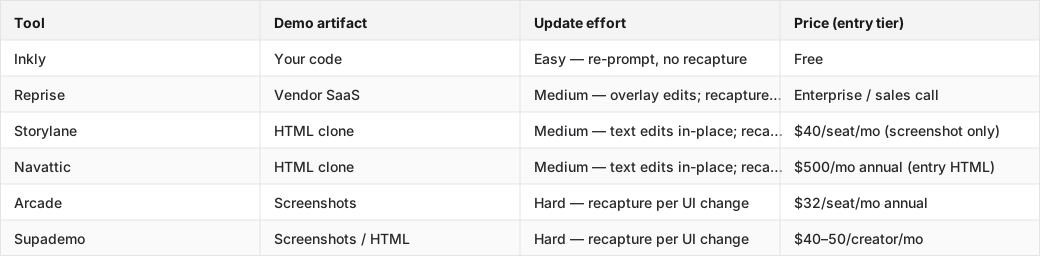
Here's how the main alternatives stack up on the axis that matters most for repo-first teams: where the demo artifact lives and what it costs to update after a product change.
Tools compared: Inkly, Reprise, Storylane, Navattic, Arcade, Supademo.
Reprise is the closest if you want the same class of product
Reprise is the most direct Demostack replacement for teams that need enterprise-grade sandbox behavior. It supports cloned product environments, branching flows, and the kind of customization a complex B2B sales motion needs. If your deal cycles are long and your buyers expect to explore a near-real product, Reprise is the migration path that keeps the most of what Demostack gave you.
The tradeoff is the same one: the demo stays inside Reprise's platform, pricing requires a sales conversation, and setup takes real work. You're trading one enterprise platform for another. For repo-first teams, that's not a solution. It's a sideways move.
Storylane, Navattic, and Arcade fit lighter demo jobs
Storylane, Navattic, and Arcade are faster to launch and better suited to marketing-led demos, the kind that live on landing pages, get embedded in emails, or run during a product-led trial. They're polished, easy to share, and don't require engineering to get started.
The structural constraint is the same across all three: the demo artifact lives in their platform. Storylane and Navattic support HTML cloning, which means text and data edits can happen in-place, but structural UI changes still require recapture. Arcade moved HTML capture to Enterprise-only in 2026, so the self-serve tier is screenshot-only, and every UI change means recapturing the affected screens. Navattic's HTML capture starts at $500/mo annual. Storylane's screenshot-only tier starts at $40/seat, but HTML, the feature that reduces recapture, starts at Growth ($500/mo annual, trial request required).
None of them let your coding agent touch the demo code, because there is no demo code to touch.
Where code-owned tools separate from all of them
The split is simple. Every tool above keeps the demo inside a vendor platform. Code-owned tools produce a demo that is a file, HTML, components, whatever the agent writes, that lives wherever you put it. Your repo, your CDN, your product docs.
That means your agent can update it the same way it updates anything else you've written. No vendor UI. No recapture workflow. No seat-based pricing on who can edit. The demo is just code.
Pick the right Demostack alternative for your team shape
Repo-first teams should optimize for editability
If you're a product engineer or founder who already uses Cursor or Claude to build the product, the question isn't which demo tool has the prettiest editor. It's which one lets you stay in the workflow you're already in. A demo that requires you to leave the repo and log into a vendor dashboard is a demo that will fall behind the product every time you ship.
The demo tools you own, where the artifact is code in your control, are the ones that stay current without a separate maintenance motion. That's the right choice for teams that ship often and can't afford a second update queue.
Marketing-led demos still want polish and speed
Product marketers and sales engineers often have different constraints. They need something shareable today, embeddable on a landing page, and presentable to a non-technical audience without involving engineering. For that job, Storylane and Arcade are genuinely better fits. The polish is higher out of the box, the sharing flow is cleaner, and the setup doesn't require a repo workflow.
The tradeoff is obvious: you're buying into a platform-update cycle. That's fine when demos are marketing assets that update quarterly. It's painful when demos need to track a product that ships weekly.
Sandbox validation belongs in a different bucket
There's a specific job where Demostack and Reprise are still the right answer: technical proof-of-concept validation, where the buyer needs to test real behavior in a controlled environment before signing. That's not a demo. It's a sandbox. And it's a different purchase than a demo tool.
If the goal is to prove product behavior to a skeptical enterprise buyer, Reprise is the right category. If the goal is to show the product to a prospect, onboard a new user, or pitch an investor, a sandbox is overkill and the maintenance cost usually isn't worth it.
Which Demostack alternative gets you live fastest without locking you in
The fastest first demo is not always the best long-term choice
Capture-first tools, Supademo, Arcade, Storylane on the screenshot tier, win on day one. You can go from product to shareable demo in under an hour without writing a line of code. For a founder who needs something for tomorrow's investor call, that speed is real.
The speed advantage fades as soon as the product changes. Every release that touches the UI becomes a recapture event. The demo you built in an hour turns into the demo you rebuild in pieces every sprint.
The maintenance bill shows up after the launch rush
Here's a simple check: push a UI change on your current branch, then open your demo. On a screenshot tool, every changed screen needs to be recaptured, because there's no in-place layout edit. On an HTML-clone tool, text and data changes can be edited in the platform, but structural changes, like a new nav, a new modal, or a reorganized sidebar, still require recapture. On a code-owned tool, you re-prompt the agent against the updated product state and commit the diff.
That gap grows with every release. A team shipping weekly on a screenshot tool is doing continuous recapture work alongside actual product work. That's the maintenance bill, and it doesn't show up in any comparison table that only measures first-capture speed.
The best Demostack alternative for repo-native teams
Why the code-owned option ranks first here
For product engineers and founders who already live in a repo and use a coding agent, Inkly is the right answer. The demo is code you own. It sits next to the product, gets reviewed in the same PR workflow, and updates when you re-prompt the agent. There's no vendor platform to log into, no seat-based pricing on who can edit, and no recapture queue building up behind every release.
The honest limitation: Inkly's MVP path is bring-your-own-agent. You need Cursor, Claude, or Codex already set up. If your team doesn't work that way yet, the workflow asks for more setup than opening Supademo and clicking record. That's a real cost for teams new to AI coding agents.
Where a lighter tool still wins
If you need something shareable today and don't want a repo workflow, Storylane's screenshot tier ($40/seat) or Arcade's Pro tier ($32/seat annual) are the cleaner first step. The demo will need recapturing when the product changes, but for a demo that updates infrequently, that's a manageable tradeoff.
Reprise is the right answer if you're migrating from Demostack specifically because you need the same class of sandbox behavior. Accept the platform dependency and the enterprise pricing. That's the cost of keeping what Demostack gave you.
Where Inkly comes in
The structural problem with every Demostack alternative in the SaaS category is the same one Demostack has: the demo artifact lives inside someone else's platform. When the product ships, you update the product. Then you update the demo. Two places, two workflows, two queues.
Inkly starts from a different premise: the demo is code you own, produced by your coding agent, and living wherever your product code lives. You vibe-code a new demo from a prompt, update it with another prompt when the product changes, and produce a variant for a new customer with a third. No re-recording. No vendor UI. No seat-based edit permissions.
The agent that builds your product can build and maintain your demo. That's the structural answer to the maintenance problem every other tool in this comparison pushes back onto your team.
FAQ
Q: Which Demostack alternative is best if I want to own and iterate on the demo like code?
Inkly is the direct answer. The demo is produced as code you own, lives in your repo, and updates when you re-prompt your coding agent (Cursor, Claude, or Codex). No other tool in this comparison produces a demo artifact you can hand to an agent for maintenance. They all keep the demo inside their platform.
Q: Which tools reduce re-recording or rebuild work when the product changes?
HTML-clone tools (Storylane, Navattic) reduce recapture for text and data changes. You can edit in-place in their platform. Structural UI changes still require recapture. Code-owned tools (Inkly) eliminate recapture entirely for both: you re-prompt the agent against the updated code and commit the diff. Screenshot-only tools (Arcade Pro, Supademo on lower tiers) require recapture for any UI change.
Q: How do the main alternatives differ on code ownership, extensibility, and update flow?
Reprise and Storylane/Navattic/Arcade all keep the demo inside their SaaS, so you edit through their UI and the artifact doesn't leave their platform. Inkly produces code you own: the demo is a file you can move to your repo, version in git, and update with any coding agent. Extensibility on platform tools is limited to what the vendor's editor supports. Code-owned demos are extensible by definition.
Q: Which option is fastest for a startup founder or product engineer to ship and maintain?
For the first demo, capture-first tools (Supademo, Arcade) are fastest, under an hour, no code required. Inkly matches that speed via the Chrome extension capture path. For ongoing maintenance, Inkly is fastest once a coding agent is in the loop, because updates are a prompt and a commit rather than a recapture workflow. The crossover happens at the first post-launch UI change.
Q: What tradeoff am I making if I leave Demostack for a lighter, AI-assisted workflow?
You're trading sandbox fidelity for maintainability and ownership. Demostack, and Reprise, can produce a near-real product environment that a technical buyer can explore. Lighter tools and code-owned tools produce a demo that shows the product but doesn't replicate its full behavior. For most demo jobs, investor pitches, prospect walkthroughs, onboarding, that tradeoff is worth it. For enterprise technical evaluations, it may not be.
Conclusion
The choice comes down to one question: where do you want the demo to live? If the answer is your repo, next to the product and updatable by the same agent that builds it, the repo-native path is the right one, and Inkly is built for exactly that workflow. If you want the closest Demostack-like experience, Reprise is the honest migration path, with the same platform dependency and enterprise pricing that comes with it. Lighter tools sit in between: faster to start, cheaper to run, but tied to a recapture cycle every time the product ships.
This week, open one demo you're currently using and check where it actually lives. If it's inside a vendor platform and your product shipped three times since you built it, you already know what the maintenance bill looks like.
Still weighing your options? See how Inkly compares to other demo platforms.
Ship your next demo before the meeting starts
Interactive demos built from your real product and kept current as you ship, done for you.


