Self serve demo vs live demo: Which one actually stays
A practical self-serve demo vs live demo decision guide: maintenance burden, conversion role, team fit, and when each format wins without constant rework.

Ship weekly for a quarter and a screenshot-based self-serve demo goes stale about thirteen times. Each change means another recapture pass across every affected screen. That math never shows up in the self-serve demo vs live demo comparison, but it should. Format choice matters more than it first appears. The real question is not which format converts better in theory. It is which one stays current without turning into a second product to maintain.
When self-serve demos beat live demos
The buyer who wants to click before they call
A lot of B2B buyers now want to look around on their own before talking to anyone. Gartner research on B2B buying behavior shows that buyers spend more time doing independent research than they do talking to suppliers. A self-serve demo gets rid of the scheduling hassle. The buyer clicks, explores, and decides whether to keep going without waiting for a slot on your calendar.
For a solo founder or small team, that matters even more. Every live demo you do not run is time you get back.
Why repeatability matters more than charm
A live demo is a performance. It scales with your time. A self-serve demo tells the same story to the tenth prospect that it told to the first, at 2am on a Saturday, without you there.
That is where self-serve wins the conversion argument. Not because it is more persuasive than a great live demo, but because it is reliably good at a volume no founder can match in person. Once your pipeline is wider than your calendar, self-serve does the heavy lifting.
When live demos still beat self-serve
The moment the buyer stops asking the product and starts asking you
Self-serve works when the product can answer the buyer's questions by itself. Once they hit an objection, like a workflow edge case, a concern about their data model, or a question about how this fits their team's process, the product cannot answer it. You can.
Late-stage enterprise deals often come down to a conversation, not a click-through. The buyer has already seen the product. Now they want to hear you think through their problem out loud. A self-serve demo cannot do that.
Why complex deals still need a human in the room
Multi-stakeholder deals add another layer. The champion who clicked through the self-serve demo still has to sell it internally to procurement, security, and a CFO who never saw the demo. A live demo with multiple people in the room lets you read the room, handle objections as they come up, and adjust the story on the fly.
Research on complex B2B sales cycles shows that deals with multiple decision-makers need active facilitation, not just information delivery. That is a live demo job, not a self-serve job.
The self-serve demo vs live demo decision matrix
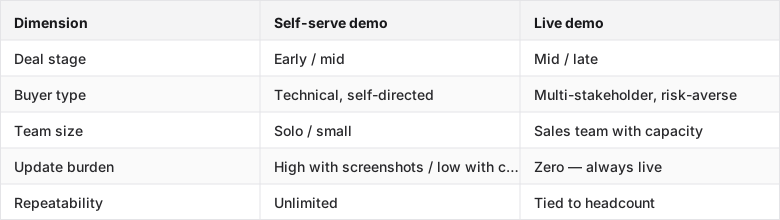
This table maps the two formats across the things that actually change the answer.
Deal stage
Early-stage deals are self-serve territory. The buyer is still deciding whether they care. A self-serve demo answers that without asking either side to spend much time. Mid-stage is where the two formats overlap. Self-serve handles the first pass, and a live demo handles the deeper discovery call. Late-stage usually needs a person. The buyer is trying to reduce risk, not just evaluate features.
Buyer type
A technical buyer — a developer, product engineer, or founder evaluating a tool — wants to click around and form their own opinion. Self-serve fits that instinct. A business buyer or a risk-averse procurement lead wants to ask questions and get straight answers. Live demo fits that instinct. The format should match how the buyer evaluates software, not what your team prefers to run.
Team size and ownership
A solo founder running self-serve demos has to keep them current. That is the hidden cost. A screenshot-based self-serve demo that ships weekly for a quarter goes stale every time the UI changes. That means roughly thirteen recapture passes. A code-owned demo turns those changes into a re-prompt. For a sales org with dedicated reps, live demos scale with headcount and the maintenance burden is basically zero. The format that creates the least ongoing work depends on what kind of demo artifact you are maintaining.
What maintenance really costs in self-serve demo vs live demo
The demo maintenance burden is where the format decision gets expensive, and where a lot of comparison guides stop too early.
Screenshot flow, HTML clone, code-owned flow
Screenshot-based self-serve demos are the most common and the most fragile. Every UI change that touches a captured screen means recapturing that screen. If a nav restructure affects eight screens, that is eight recapture passes. HTML-clone tools like Storylane and Navattic handle text and data edits in place, but structural changes still require a re-clone. Code-owned demos, where the demo is HTML and code in your repo, turn updates into a re-prompt against the existing code. One prompt. No recapture. No re-clone.
Live demos have no maintenance burden by definition. The product is the demo. Every update ships automatically.
The next release is the real bill
Maintenance is not a one-time setup cost. It shows up every time the product changes, which means every week if you are shipping weekly. A screenshot-based self-serve demo that looked great at launch starts to look off by the third sprint. That gap between the demo and the live product is what erodes trust fastest. The prospect who saw the old UI on Monday and the new UI on the call Tuesday notices.
The question is not whether you will pay the maintenance cost. It is when, and in what form. Recapture time, re-clone time, or a re-prompt.
How self-serve demos affect conversion across the funnel
Top of funnel: speed and curiosity
At the top of the funnel, the buyer is deciding whether to spend more time. A self-serve product demo answers that immediately. No scheduling. No sales cycle. No friction. The conversion event here is simple: clicked through or dropped off. Self-serve does that job better than a calendar link.
Middle of funnel: the proof gap
The middle of the funnel is where self-serve demos often fall short. The buyer has decided they are interested. Now they want to see how the product fits their actual workflow. A generic self-serve demo cannot make that connection. It shows what the product does, not what it does for this buyer's problem. That is where a live demo, or a personalized self-serve variant with buyer-specific data and branding, closes the gap.
Bottom of funnel: decision support
At the bottom, the buyer is trying to reduce risk. Self-serve demos help here as leave-behind assets, something the champion can share with stakeholders who were not on the call. A well-maintained self-serve demo that matches the current product keeps the deal moving between conversations. A stale one does the opposite.
What a strong self-serve demo needs for technical buyers
The demo has to answer real technical questions
An interactive demo vs live demo comparison for technical buyers comes down to one thing: does the self-serve demo show enough of the real product for a developer or engineer to form an honest opinion? That means current UI, real navigation paths, and actual feature depth, not a polished walkthrough that skips the parts that matter. Technical buyers will click away from something shallow faster than almost anyone else.
Analytics, monitoring, and the signal back
Self-serve only works if you can see what people do with it. Which screens did the buyer engage with? Where did they drop off? Which paths pulled them toward signup? Without that signal, you are guessing. You cannot improve the demo, spot high-intent prospects, or time the follow-up. PostHog's sales operations handbook describes the split between hands-on and self-serve buyer paths. The self-serve path only works if the engagement signal feeds back into the next step.
A practical recommendation for founders and small teams
If you ship weekly, default to self-serve
For a founder-builder shipping weekly, self-serve is the right default, but only if the demo artifact can keep up with the product. A screenshot-based self-serve demo that needs recapture on every UI change swaps one problem for another. The format that actually reduces total work is a code-owned self-serve demo: build once, re-prompt on updates, and produce per-customer variants from the same base.
Keep live demos for the deals that need them
Live demos are not obsolete. They are the right tool for late-stage deals, multi-stakeholder conversations, and any moment where the buyer's questions outrun what the product can show on its own. The goal is not to eliminate live demos. It is to stop running them for buyers who would have been fine clicking through a self-serve flow. Save the live demo for the conversations where a human actually changes the outcome.
Where Inkly comes in
The maintenance argument for self-serve demos only works if the demo artifact can keep up with the product. Screenshot-based tools like Supademo and Arcade are quick to start — you can have a shareable demo in under an hour — but every UI change means recapturing the affected screens. HTML-clone tools handle text edits in place, but they still need a re-clone when the structure changes. Neither model solves the maintenance cost that piles up when you ship weekly.
Inkly builds the demo as code you own — HTML that lives in your repo, authored by your coding agent (Cursor, Claude, Codex) and updated with a re-prompt instead of a recapture. The same Chrome-extension capture path Supademo uses gets you the first demo quickly; after that, it is a prompt. Ship a UI change on Friday, re-prompt on Monday, and the demo matches the live product before the first prospect call of the week.
The limitation is simple: Inkly needs a coding agent and a repo workflow. If your team does not work that way yet, the bring-your-own-agent path adds setup, and Supademo's all-in-platform flow may be the easier first step. But if you are already prompting your way through product work, the demo should live in your repo, not someone else's SaaS.
FAQ
Q: When should a founder choose a self-serve demo instead of a live demo to move deals faster?
When the buyer can evaluate on their own — technical buyers, early-stage prospects, anyone who wants to click before they call. Self-serve removes the calendar friction and scales beyond what any founder can run in person. If your pipeline is wider than your calendar, self-serve does the work.
Q: For a small product team, which format creates the least maintenance while staying accurate?
It depends on the artifact. Screenshot-based self-serve demos need recapture on every UI change, which gets expensive if you ship weekly. HTML-clone demos handle text edits in place but need a re-clone when the structure changes. Code-owned demos turn updates into a re-prompt. Live demos have no maintenance burden. For a small team that ships often, the lowest total maintenance is either live demos or code-owned self-serve, not screenshot-based self-serve.
Q: At what stage of the sales cycle does a self-serve demo outperform a live demo?
Early evaluation and repeated sharing. The buyer is deciding whether to spend more time, not whether to sign. Self-serve answers that question asynchronously, without scheduling. It also works as a leave-behind asset mid-funnel, something the champion can share with stakeholders who were not on the original call.
Q: When does a live demo still beat self-serve for conversion or trust-building?
Late-stage deals, multi-stakeholder conversations, and any moment where the buyer has objections the product cannot answer on its own. A risk-averse procurement lead or a CFO evaluating a six-figure contract needs to ask questions and hear a human think through the specific situation. Self-serve cannot do that.
Q: How can a team measure whether self-serve demos are reducing sales time without hurting close rates?
Track meeting load, demo completion rate, reply speed after demo shares, product-qualified handoff rate, and close rate by segment. The goal is fewer live demos with a flat or improving close rate, not just fewer demos.
Conclusion
If the buyer can evaluate on their own and your product changes often, self-serve is the right default, but only if the demo artifact can keep up with the shipping cadence. If trust, objection handling, or multi-stakeholder discovery matters more than speed, live still earns its place. Run the matrix on your own pipeline this week. Look at the last ten deals and ask which format the buyer was actually asking for at each stage. The answer is usually already there.
If you are evaluating vendors, it helps to know how Inkly compares on the things that matter after launch.
Ship your next demo before the meeting starts
Interactive demos built from your real product and kept current as you ship, done for you.


