Product marketing vs growth marketing: Who to hire first
A clear hiring framework for product marketing vs growth marketing: what each role owns, who to hire first by stage, and where the handoff line actually sits.

Open your hiring plan — the doc, the Notion page, whatever you're using — and ask a simple question: is your first marketing hire supposed to clarify what the product is, or fix why people who already understand it still aren't converting? That is the real product marketing vs growth marketing decision, and most comparison pieces never make it specific enough to be useful.
This is a stage-based hiring call, not a glossary. Here's how to think about it.
Decide whether your bottleneck is messaging or acquisition
The first-hire question nobody answers cleanly
If prospects ask "what does this actually do?" on demo calls, your problem is messaging. If prospects nod along, understand the value, and still don't convert, your problem is acquisition. Those are different problems, and they need different first hires.
Product marketing fixes the story. Growth marketing fixes the funnel. Hire in the wrong order, and the right work gets aimed at the wrong problem.
A simple bottleneck test you can run on your own team
Pull three things: your last five sales or demo call notes, your homepage, and your signup-to-activation numbers.
If the call notes show the same confusion across different prospects, the homepage over-explains without landing a clear value proposition, and your activation rate is low because people drop off before the product even loads, that's a messaging problem. Hire product marketing first.
If the call notes show people getting it quickly, the homepage converts at a decent rate, and the drop-off is in the funnel — weak click-through, poor signup conversion, bad lifecycle response — that's an acquisition problem. Hire growth first.
PostHog's take on early-stage marketing makes the same point: the right first channels depend on whether you're running a PLG or sales-led motion, and that only makes sense once the story is clear enough to test.
What product marketing owns before growth marketing shows up
Positioning, messaging, and launches are the core job
Product marketing turns what the product does into something people can understand and repeat. That usually means a positioning doc that names the customer, the problem, and why this product beats the alternative; launch pages that lead with the use case instead of the feature list; feature narratives that connect new releases to the customer's actual job.
The goal is clarity. A message tight enough that a prospect can explain your product to a colleague without you in the room.
The work that spills into onboarding and pricing
The story has to hold after signup, not just on the homepage. That's why product marketing reaches into onboarding copy, pricing pages, and the first email sequence. The first-run experience has to confirm what the homepage promised. The tier names and feature groupings need to make sense. The email sequence should reinforce the value the user came for, not wander off into feature tours.
A positioning doc that stops at the homepage is only half a job. Product marketing owns the full arc from "I heard about this" to "I understand why I'm using this."
What growth marketing owns when the funnel is the problem
Channels, campaigns, and experiments are the job
Growth marketing runs acquisition. Channel tests, paid campaigns, SEO, referral loops, viral mechanics — growth owns the experiments that figure out where users come from and what makes them convert. The job is not to build the story. It's to see how far the existing story travels across different surfaces.
The numbers matter here: click-through rates, cost per acquisition, signup conversion, experiment velocity. Growth marketing lives or dies by whether those move.
Why lifecycle email and activation belong here
Once a user signs up, the job shifts from acquisition to activation, and growth marketing owns that handoff. Onboarding email sequences, in-app nudges, activation experiments, and conversion tests all sit here. Product marketing sets the message. Growth tests whether that message, delivered at the right moment in the right channel, actually gets users to do the thing that matters.
Vercel's growth marketing job description frames it pretty clearly: growth works with product, demand generation, and data to send lifecycle communications that drive measurable outcomes. Personalized. Iterative. Measurable. That's the job.
Hire product marketing before growth marketing when the story is broken
What a weak message looks like in the wild
Founder symptoms are usually obvious once you know what to look for. Prospects ask the same basic question on every call: "So is this for X or Y?" The homepage has three paragraphs where one sentence should do the job. Every onboarding conversation starts with someone re-explaining what the product is. The sales deck and the website do not quite say the same thing. The team debates positioning on every launch.
That usually means the story is not set yet.
Why more traffic only makes the confusion louder
Throwing growth spend at a muddy message does not fix the message. It just scales the confusion. More clicks to a homepage that does not convert means more wasted spend. A better lifecycle email sequence built on unclear positioning just delivers the wrong message faster.
Product marketing vs growth marketing is a sequencing question, not a taste question. Positioning first, then acquisition. The growth hire is expensive when they are sending traffic to something that does not convert. They are much cheaper when the thing already works.
Hire growth marketing before product marketing when the message is clear and conversion is weak
When the product already makes sense
The opposite case is pretty common too. Prospects get the value fast. The homepage is clear. Onboarding makes sense. But signup-to-activation is low, paid channels are not scaling, and lifecycle email is not moving users to the right behavior. The story is fine. The funnel is leaking.
That is a growth problem.
What gets measured first
A growth marketing hire in this situation starts with funnel metrics: click-through on acquisition channels, signup conversion rate, time-to-first-value, lifecycle email open and click rates, and activation percentage. Those numbers show where the leak is. The work is about fixing it — A/B tests on landing pages, channel mix experiments, onboarding flow changes, lifecycle sequence rewrites.
Growth marketing vs product marketing here is diagnosis, not preference. If the metrics point to acquisition, the growth hire is the right call.
Use a stage-based first-hire framework for pre-PMF, seed, and Series A
Pre-PMF means message first, usually
Pre-product-market-fit teams are still figuring out who the product is for and what to say to them. That's a product marketing problem, not a growth problem. Running acquisition experiments before the message is clear just creates noisy data. You cannot tell whether the channel is bad or the message misses.
Pre-PMF founders should do the product marketing work themselves: customer interviews, positioning iterations, homepage rewrites. If there is an external marketing hire, it should be someone with product marketing instincts.
Seed and Series A split on bottleneck and volume
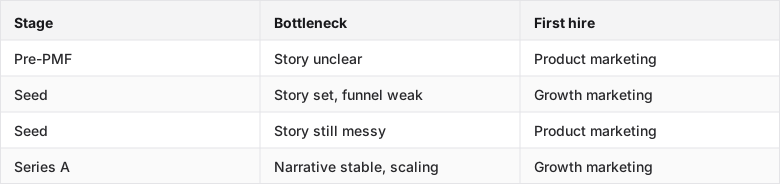
At seed, the question is whether the message is set enough to scale. If launches are still messy, the narrative changes every month, and the sales team is still improvising positioning on calls, product marketing wins. If the story is stable and the bottleneck is repeatable acquisition, growth comes first.
Series A usually has both problems, just with more budget. The split still comes down to the bottleneck. If the Series A story is crisp and the funnel is the constraint, hire growth first. If the narrative is still being worked out, which happens a lot after a pivot or a major product expansion, hire product marketing first.
A compact stage table the reader can scan
Here's the stage-by-stage recommendation:
Draw the ownership line for landing pages, onboarding, lifecycle email, and pricing tests
Where product marketing hands off
Product marketing owns the message — the positioning doc, the launch narrative, the homepage copy, the pricing page structure, the onboarding copy that confirms the value proposition. Growth marketing owns the experiments that test that message in market: landing page A/B tests, lifecycle email sequences, activation experiments, channel tests.
The handoff is simple: message is set, then growth can experiment. Growth does not set the message. Product marketing does not run the experiments.
What the RACI should say
A clean split across the four surfaces that cause the most overlap:
Landing pages: product marketing owns the message and the initial copy; growth owns conversion experiments and iterates on that copy through testing.
Onboarding: product marketing owns the narrative arc and the copy that confirms the value proposition; growth owns the activation experiments and lifecycle sequences that move users through the funnel.
Lifecycle email: product marketing sets the message and tone; growth owns the sequencing, timing, A/B tests, and performance metrics.
Pricing tests: product marketing owns the pricing page structure and the story the tiers tell; growth owns conversion experiments on the page itself.
The overlap usually shows up in copy-heavy experiments. In the cleanest teams, product marketing approves the message and growth tests the execution.
FAQ
Q: What is the real difference between product marketing and growth marketing in a SaaS company?
Product marketing sharpens the story: positioning, messaging, launches, and the narrative that runs from homepage through onboarding. Growth marketing sharpens the funnel: acquisition channels, conversion experiments, lifecycle email, and activation. One function decides what to say; the other decides how to get more people to hear it and act on it.
Q: Which role should an early-stage founder hire first if they need users now but messaging is still unclear?
Hire product marketing first. Traffic without a clear message creates noisy data and wasted spend. You cannot tell if the channel is bad or the message misses. Get the story tight enough that a prospect can explain your product to a colleague without you in the room, then bring in growth to scale acquisition against that story.
Q: Where exactly does product marketing end and growth marketing begin on messaging, launches, onboarding, and conversion?
Product marketing owns the message on all four surfaces: positioning, launch narrative, onboarding copy, and pricing page structure. Growth owns the experiments that test and optimize that message in market: landing page A/B tests, activation experiments, lifecycle sequences, conversion rate work. The handoff is simple: message set, then growth experiments.
Q: Who should own landing pages, lifecycle email, pricing tests, and activation experiments?
Landing pages: product marketing owns the initial copy and message; growth owns conversion testing. Lifecycle email: product marketing sets the narrative; growth owns sequencing, timing, and performance. Pricing tests: product marketing owns the page structure and tier story; growth owns conversion experiments on it. Activation experiments: growth owns these end-to-end, with product marketing input on copy that touches positioning.
Q: How do these roles differ in metrics, deliverables, and success criteria?
Product marketing is measured on message clarity, launch performance, and whether the positioning holds up across channels and conversations. Deliverables are positioning docs, launch briefs, homepage copy, and pricing page structure. Growth marketing is measured on click-through rates, signup conversion, activation percentage, and cost per acquisition. Deliverables are experiment results, lifecycle sequences, and channel performance reports. One role is judged on whether the story is right; the other on whether the numbers move.
Conclusion
If your story is broken — prospects are confused, the homepage over-explains, every sales call starts with re-explaining the product — hire product marketing first. If the story is clear and the funnel is leaking — low activation, weak acquisition, lifecycle email that does not convert — hire growth first.
This week: score your current bottleneck against the test in section one. Pull your call notes, your homepage, and your activation rate. One of them will tell you which problem you actually have. Write the first-hire brief from that answer, not from which role sounds more impressive.
See how marketing teams use Inkly to turn website visitors into conversations.
Ship your next demo before the meeting starts
Interactive demos built from your real product and kept current as you ship, done for you.


